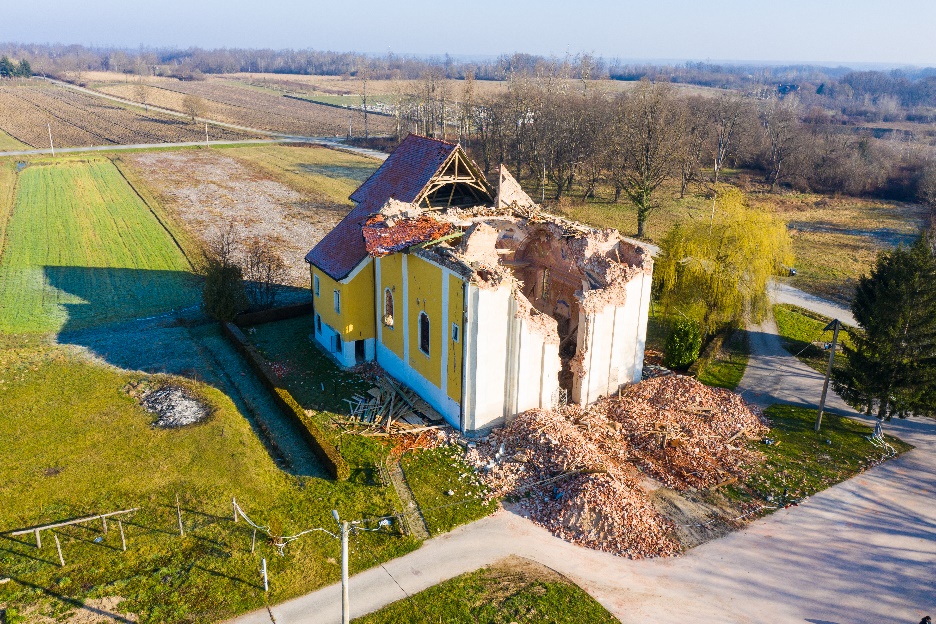
The project addresses a critical gap in current knowledge and practice by developing a comprehensive, interdisciplinary methodology for the assessment, preservation, and strengthening of these culturally significant yet vulnerable structures.
Context and Problem Statement
For centuries, stone and brick have been dominant building materials in the Mediterranean, shaping its architectural identity. Historical masonry is a craft-based product, influenced by material availability, construction period, and builder skill. These structures, particularly smaller and medium-sized sacred buildings like parish churches and chapels, are integral to cultural heritage but are highly vulnerable to seismic activity. Recent earthquakes in Croatia (2020), Turkey, Italy, and Greece have caused severe damage to thousands of historical buildings, underscoring the urgent need for effective resilience strategies. In Croatia alone, the 2020 earthquakes damaged over 57,000 buildings, including 308 protected cultural assets and 256 sacred objects, with estimated restoration costs exceeding one billion euros. Despite their social and ethnographic value, these buildings are often under-researched and lack standardized, normative procedures for assessment and retrofitting.
Research Goals and Methodology
The ARTHUR project aims to fill this void through a multi-level approach that integrates structural engineering, social sciences, and digital technology. Key objectives include:
- Developing a standardized classification and database for the mechanical properties of stone and mixed stone-brick masonry specific to the Croatian context.
- Adapting and calibrating the Masonry Quality Index (MQI) method, a visual assessment tool for estimating mechanical properties, to improve its accuracy for local traditional construction.
- Conducting advanced seismic assessment using in-situ tests (e.g., flat-jack tests), ambient vibration measurements, and analytical methods according to Eurocode 8, including linear and non-linear analyses.
- Creating empirical vulnerability curves for Croatian churches, building upon methodologies developed for Italian masonry churches, to better predict seismic performance and damage.
- Integrating social and community factors into resilience strategies, recognizing the deep community ties and ethnographic value of these buildings.
- Employing digital technologies such as 3D laser scanning (LiDAR), BIM modelling, and 3D printing for documentation, analysis, and educational dissemination.
Innovation and Interdisciplinary Approach
The project is highly interdisciplinary, bridging technical fields (civil engineering, materials science, geodesy) with natural sciences (seismology, applied mathematics), social sciences (economics, law), and humanities (heritage conservation, sociology, ethnology). It builds upon the principal investigator’s prior work in the ARES project, which focused on URM residential buildings, and extends it to the more complex typology of sacred architecture.
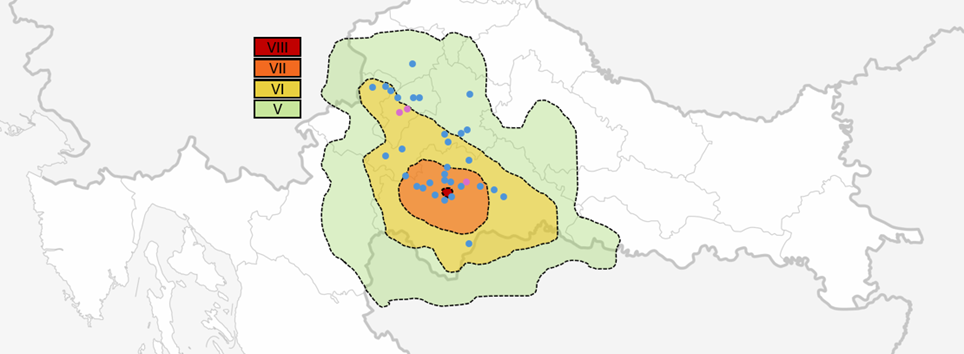
The research will systematically collect and categorize data from approximately 50 churches, utilizing both existing restoration project data and new field investigations. Guidelines from international bodies like ICOMOS and ISCARSAH will ensure consistency and comparability.
Locations of churches that will be investigated within the project. Rural churches are marked in blue, while urban and city churches are marked in purple. The map shows the intensity of the Petrinja earthquake according to EMS-98
Innovation and Interdisciplinary Approach
The project is highly interdisciplinary, bridging technical fields (civil engineering, materials science, geodesy) with natural sciences (seismology, applied mathematics), social sciences (economics, law), and humanities (heritage conservation, sociology, ethnology). It builds upon the principal investigator’s prior work in the ARES project, which focused on URM residential buildings, and extends it to the more complex typology of sacred architecture. The research will systematically collect and categorize data from approximately 50 churches, utilizing both existing restoration project data and new field investigations. Guidelines from international bodies like ICOMOS and ISCARSAH will ensure consistency and comparability.
Expected Outcomes and Impact
The expected outcomes are:
- A refined, context – specific MQI methodology for Croatian historical masonry.
- A reliable database of mechanical properties for stone and mixed masonry.
- Validated vulnerability assessment models and fragility curves for sacred buildings.
- Practical, community – oriented guidelines for seismic retrofitting that respect heritage conservation principles.
- Digital 3D models and physical scale models for education and public awareness.
The results will significantly contribute to preserving cultural heritage, reducing seismic risk, and providing a transferable framework for similar regions in the Mediterranean. The project aligns with multiple global initiatives, including the Sendai Framework for Disaster Risk Reduction, UN Sustainable Development Goals (particularly 9, 11, and 12), UNESCO recommendations, and the New European Bauhaus initiative.
In essence, the ARTHUR project seeks to “draw knowledge from stone and brick” – much like the legendary king drew Excalibur from the stone – to safeguard sacred architectural heritage for future generations through innovative, resilient, and holistic strategies.