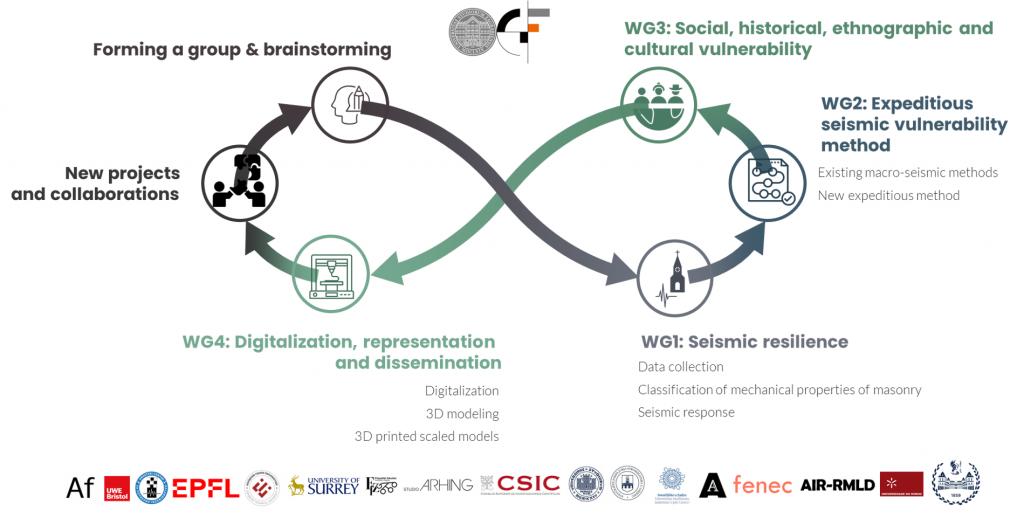
The ARTHUR project is designed to provide a comprehensive understanding of the resilience of sacred architecture through the integration of structural, social, and technological analyses. This approach addresses specific challenges associated with historical and understudied religious buildings, with a particular focus on their seismic vulnerability and cultural significance. The project is structured into four interdependent Work Groups (WGs), each targeting a key dimension of assessment and intervention.
WG1: Seismic Resilience
WG1 focuses on the structural and mechanical assessment of unreinforced masonry, typical of historic churches. It is divided into three main tasks:
- T1.1 Data Collection: A systematic gathering and classification of data from approximately 50 professional restoration projects provided by team members. This is supplemented by information from the Croatian Earthquake Engineering Centre (HCPI) database, containing records on over 70,000 inspected buildings (including churches), and data from the Ministry of Spatial Planning, Construction and State Assets. Additional analyses will include archival data, conservation studies, post-earthquake damage reports, and related restoration strategies.
- T1.2 Classification of Masonry Mechanical Properties: This task involves analyzing existing flat-jack test data and conducting new in-situ tests to measure shear strength and modulus of elasticity. Data from a completed doctoral dissertation on the experimental evaluation of unreinforced masonry will also be utilized. The Masonry Quality Index (MQI) method will be applied and specifically calibrated for the Croatian building stock, with a focus on stone and mixed masonry. Additional investigations include endoscopic surveys, examination of structural connections, and measurements of brick and mortar properties. The outcomes include an adapted MQI method for Croatia and a catalog of damage mechanisms to serve as a future reference.
- T1.3 Seismic Response Assessment: Following classification, seismic resilience will be evaluated using a combination of linear (from existing projects) and nonlinear analyses. Local analyses of damage mechanisms will complement global assessments. Discrete Element Modeling (DEM) will be employed for complex structures like bell towers and domes. Models will be validated based on observed damage from Croatian earthquakes and Operational Modal Analysis (OMA) data. This integrated approach aims to develop robust vulnerability models tailored to Croatian sacred architecture, with potential for global adaptation.
WG2: Rapid Seismic Vulnerability Assessment Method
WG2 is dedicated to developing a practical, expedited method for assessing the seismic vulnerability of churches.
- T2.1 Analysis of Existing Macroseismic Methods: The assessment begins by collecting key vulnerability-influencing data from WG1 and linking it to vulnerability forms. Initial parameters will be drawn from established methods (e.g., Benedetti & Petrini, Vicente, Savvas) and a recently defended doctoral dissertation (Ožić, 2025).
- T2.2 Development of a New Rapid Assessment Method for Churches: Since most existing methods are not tailored for churches, additional parameters specific to sacred architecture will be incorporated. These include the presence of vaults, arches, and domes; bell tower characteristics; the influence of large windows; structural configuration; roof structure; and past modifications. A final list of parameters will be defined after extensive statistical analysis, employing multiple logistic regression to quantify the relationship between building characteristics and damage levels. The resulting regression coefficients will be used to define numerical weighting factors for each parameter, forming the basis for a calibrated, context-specific rapid assessment methodology.
WG3: Social, Historical, Ethnographic, and Cultural Vulnerability
WG3 investigates the non-structural dimensions of vulnerability through extensive fieldwork and community engagement.
- Methodology: Interviews with local communities will be conducted for several representative churches to understand cultural significance, risk perception, and historical narratives related to earthquakes or other traumatic events. An innovative approach involves using an AI-based tool to assess stress levels during interviews via specialized visual questionnaires and video analysis.
- Assessment Parameters: Drawing on methodologies from Romanian studies, a wide range of architectural and cultural parameters will be examined. These include: architectural style, age, original craftsmanship, artistic elements (statues, frescoes), authenticity, monument status, construction techniques, state of preservation, archaeological significance, and past restoration works. Additional parameters will assess iconographic features, liturgical furniture, use of precious materials, and acoustic qualities.
- Urban and Socio-Economic Context: The study will also examine urban parameters (the building’s role in defining a settlement’s profile, integration into the landscape, proximity to community centers) and socio-economic importance (function as a community hub, role in preserving traditions, economic value, and tourism potential).
WG4: Digitization, Representation, and Dissemination
WG4 ensures the effective documentation, visualization, and communication of the project’s processes and findings.
- T4.1 Digitization and Representation: Churches will be documented using laser scanning or LiDAR systems to create accurate 3D models. These will be used to produce detailed physical scale models via 3D printing, employing multi-color printers for texture and damage pattern representation and clay printers for tactile, material-faithful replicas. Separate models will show original geometry and proposed restoration strategies. Selected churches will also be modeled in 3D environments with potential for Virtual Reality (VR) applications, serving as educational platforms.
- T4.2 Dissemination: A strong dissemination plan includes publishing at least six scientific and seven conference papers, targeting engineers, scientists, and the public through professional organizations like ICOMOS and ISCARSAH. A LinkedIn page and YouTube channel will be established. Workshops for the local community, regular lectures for faculty and students, and integration of project themes into thesis work are planned. The Principal Investigator’s (PI) extensive prior experience leading the ARES project, which resulted in 23 publications and presentations on three continents, provides a proven framework for effective outreach. The PI’s role as Vice-President of ICOMOS Croatia will further facilitate dissemination within the heritage conservation community. Physical 3D models will be donated to local communities to promote interest in built heritage.
Overall Integration and Risk Management
The ARTHUR methodology is inherently multidisciplinary, weaving together engineering analysis, social science, cultural heritage studies, and digital technology to create a holistic framework for resilience. A detailed risk management strategy addresses potential organizational, technical, financial, and dissemination challenges, leveraging the team’s established expertise, prior project experience (ARES), and strong institutional support to ensure successful implementation and impactful results.